Qureshi urges US to stay in Afghanistan for 5 years

Tuesday, December 1, 2009 |


Updated at: 1824 PST, Tuesday, December 01, 2009

ISLAMABAD: Pakistan Foreign Minister Makhdoom Shah Mehmood Qureshi said the US should not leave Afghanistan for at least five years, Geo News reported Tuesday.Pakistan can cope well with extremism if provided with drone technology; therefore, the US should deliver this technology to the country, he said adding the US drone attacks pose a threat to security and sovereignty of Pakistan. He urged the US not to quit Afghanistan until the mission is completed.The FM Qureshi said the elimination of the terrorism is in the interest of both India and Pakistan.

SC to hear petitions against NRO from Dec 7

|


Updated at: 1952 PST, Tuesday, December 01, 2009 ISLAMABAD: Supreme Court (SC) has constituted a larger bench to hear the petitions against the National Reconciliation Ordinance (NRO), Geo News reported Tuesday.The larger bench of the apex court will start hearing the petitions from December 7.According to sources, the SC has issued notices the counsels of all petitioners including Attorney General of Pakistan.

Pakistan's president told to give up powers

Sunday, November 29, 2009 |


By CHRIS BRUMMITT Associated Press Writer © 2009 The Associated Press

Nov. 29, 2009, 10:40AM

ISLAMABAD — Pakistan's main opposition party Sunday demanded the president give up the sweeping powers he inherited from his predecessor, setting the stage for political turmoil just as the Obama administration wants the country to focus on fighting the Taliban.

President Asif Ali Zardari's grip on power is increasingly under threat from opposition lawmakers and elements within the powerful military who want him to resign or divest powers to the prime minister and take on a ceremonial role. Opinion polls show him to be desperately unpopular 15 months into a five-year term.

His presidency suffered another blow Saturday when an amnesty protecting him, several key allies and thousands of other officials from graft prosecution expired. While he enjoys immunity from prosecution as president, opponents could now go to the Supreme Court to challenge his eligibility for office.Adding to a sense of a government under siege, Taliban militants have unleashed a surge of suicide bombings in recent weeks in response to an army offensive into one of their strongholds close to the Afghan border, killing hundreds of people.The nuclear-armed country's Western backers had hoped Zardari and the civilian government he leads would usher in political stability after the chaos that marked the end of the nine-year tenure of his predecessor, military ruler Gen. Pervez Musharraf. Zardari took the presidency months after his wife, former Prime Minister Benazir Bhutto, was killed in a suicide bombing at the end of 2007.A major factor in his unpopularity are the many presidential powers he took from Musharraf, who staged a 1999 military coup and resigned last year amid nationwide protests. Among the most important are the authority to fire an elected government and appoint top military chiefs.On Friday, Zardari transferred another Musharraf-era power — the command of the country's nuclear arsenal — to Prime Minister Yousuf Raza Gilani. The move, which had no impact on nuclear security, was seen as an attempt to allay some of his critics within the military by giving up some authority.Shahbaz Sharif, the brother of main opposition leader Nawaz Sharif and chief minister of Pakistan's largest province, Punjab, said Zardari should act to now to transfer the other powers to the prime minister, noting that the president had already promised to do so."The nation would appreciate this act," Sharif told reporters Sunday.Late Sunday, Zardari said he would make an announcement "soon" on changes to the constitution needed to divest those powers, but the statement gave no specifics. He already promised at least twice give up some of his authority to the prime minister since taking office.He also took a swipe at his critics, saying the democratically elected government "was being subjected to a vicious campaign to tarnish its image by the remnants of dictatorship."The political upheaval comes as President Barack Obama's administration is expected to announce this week a new strategy for defeating the Taliban in neighboring Afghanistan and on Pakistan's northwestern border. To have much hope of success, the U.S needs a stable Pakistani government committed to fighting militants blamed for attacks in both countries.Pakistan's original constitution envisages a parliamentary style of government in which a popularly elected prime minister is the chief executive and the president is a ceremonial head of state. But Musharraf, who was widely despised when he stood down, accumulated powers to stay in office.Shabaz Sharif did not repeat a remark by one opposition lawmaker on Saturday calling on Zardari to resign, neither did he call for anti-government street rallies, perhaps wary of pushing the country into chaos and paving the way for more military rule.Some analysts have said they believe opposition leader Nawaz Sharif — whom opinion polls show to be the most popular politician in the country by far — would prefer to wait for national elections that he is seen likely as winning than join any movement to push Zardari out. Such a drive would likely require the support of the army, which has had uneasy relations with Sharif in the past.That reluctance could help Zardari complete his term so long as he takes on a ceremonial role, analysts say, especially given that impeaching him looks all but impossible because the party he heads is the largest in parliament.Zardari, 54, has long been haunted by corruption allegations dating back to governments led by his late wife, Bhutto.He denies any wrongdoing. He spent several years in prison under previous administrations in connection with the allegations which he says were politically motivated.Since taking office, the president has found himself locked in a power struggle with the powerful military, which sees defense policy and relations with India and Afghanistan as its responsibility despite being nominally under civilian control.Military chiefs have objected to his friendly overtures toward India and his acceptance of a multibillion dollar U.S. aid bill that came with conditions they feared imposed controls over the army.

Associated Press writer Asif Shahzad contributed to this report.

7 critical after La. highway wreck that killed 5

|

By MARY FOSTER, Associated Press Writer Mary Foster, Associated Press Writer – 2 mins ago
NEW ORLEANS – Four children ages 2 to 14 were among five people killed when a minivan packed with kids rolled on a Louisiana interstate, and seven others remained in critical condition, state police said Sunday.
None of the 13 children in the van was wearing a seatbelt, and all were thrown from the vehicle. The van didn't have enough seatbelts for everyone and probably couldn't have safely carried more than 10, police spokesman Russell Graham said.
"I just saw the vehicle flip about three or four times and kids flying everywhere," witness Tammy Hall told WAFB-TV. "It looked to be about 10 to 11 kids out of the car. And everyone started stopping, and we went to get her, and you could tell the driver was dead instantly."
Two other children and the GMC Safari's adult passenger were in stable condition. The surviving children ranged from less than a year old to 14, Louisiana State Police said in a news release.
Police identified the dead as the driver, 38-year-old Mona Hines; 2-year-old Ricky Hines Jr.; 12-year-old Lachante Floyd; 14-year-old Edward Barnes; and 14-year-old Ashley Hines.
Authorities have said the van blew a tire, clipped a delivery truck and rolled on Interstate 10 near Baton Rouge.
The driver of the truck managed to steer to the side of the road and was not injured.
Alcohol was not suspected as a factor in the crash.
Some people in the van were family members from Harvey, La., about 75 miles northeast of the crash site, Graham said. He did not know where the van was going.
"The Louisiana Legislature just passed a law making it mandatory to wear seatbelts in both the front and back seats," Graham said. "This is a good illustration of why they did."

U.N. board votes to censure Iran

Saturday, November 28, 2009 |


In a rare show of global solidarity, nations demanded a halt now to enrichment work.

By Glenn Kessler and Joby Warrick
Washington Post
WASHINGTON - The resounding censure of Iran yesterday by the board of the International Atomic Energy Agency, the U.N. nuclear watchdog, signals the start of a potentially more confrontational phase in the Obama administration's dealings with the Islamic republic, including the prospect of strengthened U.S.-led efforts to cut off Iran's economic links to the world.

Iran will face a "package of consequences" if it does not soon become a "willing partner" in talks on its nuclear ambitions, a senior U.S. official warned, speaking on condition of anonymity. "We hope Iran takes note of that clear message.

The 35-nation board approved, 25-3, a resolution rebuking Iran for its continued defiance of U.N. resolutions that demand a halt to uranium enrichment and other activities that U.S. officials think are aimed at developing nuclear weapons. The declaration is particularly critical of Iran's secret construction of a second enrichment plant inside mountain bunkers near the ancient city of Qom, southwest of Tehran.

The resolution, which was supported by China and Russia, two longtime skeptics of taking a hard line against Iran, said the government's failure to notify the IAEA of the project was a "breach of its obligation" under U.N. treaties.

The resolution will be referred to the U.N. Security Council, which has the authority to enact sanctions against the country. During the Bush administration, China and Russia worked to soften sanctions against Iran during negotiations in the Security Council.

Iranian officials called the IAEA resolution "a historic mistake" and threatened to curtail their cooperation with the agency. Tehran has said the nuclear program is intended only to produce electricity.

In devising additional means of pressuring Iran, U.S. officials are focused on making it difficult for Iranian companies to ship goods. They are thus targeting insurance and reinsurance companies that underwrite the risk of such transactions, especially businesses that help support Iran's military elite. Such measures would build on an approach initiated by the Bush administration and by three sets of existing U.N. sanctions against Iran.

"Nothing that we contemplate or that we would consider is aimed at causing greater harm for the Iranian people, who have suffered enough," the U.S. official said.

When President Obama took office, he said that he would seek to engage Iran - and that Tehran would have until the end of this year to demonstrate it would respond seriously.

Obama reached out in speeches and issued a video message to the Iranian people. He sent two private letters to Iran's supreme leader, Ayatollah Ali Khamenei, the country's key decision-maker in matters of security and foreign policy, and joined with Russia and France in offering to help supply new fuel for an aging medical reactor in Tehran. But the missives have gone largely unanswered - apart from public scorn from Iranian leaders - and the reactor deal has not won government approval.

After months of effort, one of the few tangible achievements the administration can point to is the willingness of China and Russia to support yesterday's resolution.

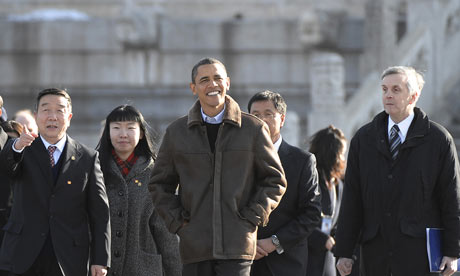
Barack Obama tours the Forbidden City, home of China's emperors

Tuesday, November 17, 2009 |


President takes a break from talks to explore 'a testament to the greatness of Chinese history'

Barack Obama is escorted around the Forbidden City in Beijing. Photograph: Andy Wong/AP

Wong/AP
Barack Obama took a break from bilateral discussions this afternoon to play tourist at the Forbidden City, one of China's best-loved historical sites.
The authorities closed off the former imperial palace in Beijing so the US president could spend almost an hour undisturbed in its maze of vermilion buildings and courtyards, explored by millions of visitors each year.
Dating back to the 15th century, the complex was home to 24 Chinese emperors who ruled for almost 500 years, between 1420 and 1911.
"It's a testament to the greatness of Chinese history," said Obama, who had put on a jumper and a brown sheepskin jacket to ward off the Beijing chill. Snow dotted roofs and there were patches of ice in the courtyards.
Obama said it was "a magnificent place to visit" and he wanted to return with his wife and daughters, adding that he would like to visit other parts of the country. This is his first trip to China.
Standing in the Hall of Supreme Harmony – where Ming and Qing dynasty emperors held their enthronements and weddings – he asked the museum curator, Zheng Xinmiao, to explain to him the characters on the board hanging in the middle of the hall, Chinese media reported.
Zheng explained that it read "Jian Ji Sui You", meaning "Emperors should make good rules". The principle seems equally applicable to presidents, although Obama may sometimes yearn for the kind of domestic power the Forbidden City's former occupants enjoyed.
The site, now known as the Palace Museum, is in the heart of the capital and covers approximately 150,000 square metres.
Obama is due to visit a stretch of the Great Wall near Beijing tomorrow, before flying out to South Korea for the last stretch of his four-nation tour of Asia.

Pakistan more corrupt than India, says international watchdog

|

17 Nov 2009, 1905 hrs IST, IANS
NEW DELHI: Pakistan, with a ranking of 139, is perceived to be more corrupt than India by global corruption watchdog Transparency International in its latest survey of 180 countries.
The 2009 Transparency International survey, released worldwide Tuesday, has ranked India 84th among the 180 countries assessed for integrity.
According to the findings of the independent organisation which tracks prevalence of corruption worldwide, Pakistan's integrity score stands at 2.4 on the scale of 0 (perceived as highly corrupt) to 10 (least corrupt).

India, which shares the 84th spot with El Salvador, Guatemala, Panama and Thailand, has an integrity score of 3.4.
Pakistan has, in fact, slipped a notch below on the integrity score from 2.5 in 2008. China, which was ranked a joint 72nd with India in 2007, has improved its corruption perception. It is ranked 79th and its integrity score is 3.6. The least corrupt country in the South Asian region is the fledgling democracy of Bhutan, which has scored a good 5.0 and is at 49th spot. New Zealand, Denmark, Singapore, Sweden and Switzerland occupy the top five places as the least corrupt nations of the world, while at the bottom of the table come Somalia and Afghanistan.