 RSS Feed


Updated at: 1952 PST, Tuesday, December 01, 2009 ISLAMABAD: Supreme Court (SC) has constituted a larger bench to hear the petitions against the National Reconciliation Ordinance (NRO), Geo News reported Tuesday.The larger bench of the apex court will start hearing the petitions from December 7.According to sources, the SC has issued notices the counsels of all petitioners including Attorney General of Pakistan.
Showing posts with label TOP STORIES. Show all posts
Showing posts with label TOP STORIES. Show all posts
SC to hear petitions against NRO from Dec 7
 Tuesday, December 1, 2009 |

 0
comments
 Labels:
TOP STORIES
U.N. board votes to censure Iran
Saturday, November 28, 2009 |

In a rare show of global solidarity, nations demanded a halt now to enrichment work.
By Glenn Kessler and Joby Warrick
Washington Post
WASHINGTON - The resounding censure of Iran yesterday by the board of the International Atomic Energy Agency, the U.N. nuclear watchdog, signals the start of a potentially more confrontational phase in the Obama administration's dealings with the Islamic republic, including the prospect of strengthened U.S.-led efforts to cut off Iran's economic links to the world.
Iran will face a "package of consequences" if it does not soon become a "willing partner" in talks on its nuclear ambitions, a senior U.S. official warned, speaking on condition of anonymity. "We hope Iran takes note of that clear message.
The 35-nation board approved, 25-3, a resolution rebuking Iran for its continued defiance of U.N. resolutions that demand a halt to uranium enrichment and other activities that U.S. officials think are aimed at developing nuclear weapons. The declaration is particularly critical of Iran's secret construction of a second enrichment plant inside mountain bunkers near the ancient city of Qom, southwest of Tehran.
The resolution, which was supported by China and Russia, two longtime skeptics of taking a hard line against Iran, said the government's failure to notify the IAEA of the project was a "breach of its obligation" under U.N. treaties.
The resolution will be referred to the U.N. Security Council, which has the authority to enact sanctions against the country. During the Bush administration, China and Russia worked to soften sanctions against Iran during negotiations in the Security Council.
Iranian officials called the IAEA resolution "a historic mistake" and threatened to curtail their cooperation with the agency. Tehran has said the nuclear program is intended only to produce electricity.
In devising additional means of pressuring Iran, U.S. officials are focused on making it difficult for Iranian companies to ship goods. They are thus targeting insurance and reinsurance companies that underwrite the risk of such transactions, especially businesses that help support Iran's military elite. Such measures would build on an approach initiated by the Bush administration and by three sets of existing U.N. sanctions against Iran.
"Nothing that we contemplate or that we would consider is aimed at causing greater harm for the Iranian people, who have suffered enough," the U.S. official said.
When President Obama took office, he said that he would seek to engage Iran - and that Tehran would have until the end of this year to demonstrate it would respond seriously.
Obama reached out in speeches and issued a video message to the Iranian people. He sent two private letters to Iran's supreme leader, Ayatollah Ali Khamenei, the country's key decision-maker in matters of security and foreign policy, and joined with Russia and France in offering to help supply new fuel for an aging medical reactor in Tehran. But the missives have gone largely unanswered - apart from public scorn from Iranian leaders - and the reactor deal has not won government approval.
After months of effort, one of the few tangible achievements the administration can point to is the willingness of China and Russia to support yesterday's resolution.
0
comments
Labels:
TOP STORIES
Barack Obama tours the Forbidden City, home of China's emperors
Tuesday, November 17, 2009 |
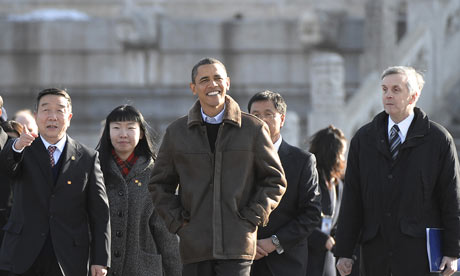
President takes a break from talks to explore 'a testament to the greatness of Chinese history'
Barack Obama is escorted around the Forbidden City in Beijing. Photograph: Andy Wong/AP
Wong/AP
Barack Obama took a break from bilateral discussions this afternoon to play tourist at the Forbidden City, one of China's best-loved historical sites.
The authorities closed off the former imperial palace in Beijing so the US president could spend almost an hour undisturbed in its maze of vermilion buildings and courtyards, explored by millions of visitors each year.
Dating back to the 15th century, the complex was home to 24 Chinese emperors who ruled for almost 500 years, between 1420 and 1911.
"It's a testament to the greatness of Chinese history," said Obama, who had put on a jumper and a brown sheepskin jacket to ward off the Beijing chill. Snow dotted roofs and there were patches of ice in the courtyards.
Obama said it was "a magnificent place to visit" and he wanted to return with his wife and daughters, adding that he would like to visit other parts of the country. This is his first trip to China.
Standing in the Hall of Supreme Harmony – where Ming and Qing dynasty emperors held their enthronements and weddings – he asked the museum curator, Zheng Xinmiao, to explain to him the characters on the board hanging in the middle of the hall, Chinese media reported.
Zheng explained that it read "Jian Ji Sui You", meaning "Emperors should make good rules". The principle seems equally applicable to presidents, although Obama may sometimes yearn for the kind of domestic power the Forbidden City's former occupants enjoyed.
The site, now known as the Palace Museum, is in the heart of the capital and covers approximately 150,000 square metres.
Obama is due to visit a stretch of the Great Wall near Beijing tomorrow, before flying out to South Korea for the last stretch of his four-nation tour of Asia.
0
comments
Labels:
TOP STORIES
Stigma part of breast cancer's grip on poor
Monday, November 2, 2009 |
By LAURAN NEERGAARD, AP Medical Writer Lauran Neergaard, Ap Medical Writer – 27 mins ago
WASHINGTON – Nurses were training women in rural Mexico to examine their breasts for cancer when one raised her hand to object. If she lost her breast, Harvard public health specialist Felicia Knaul recalls the woman saying, "My man would leave me" — and with him, the family's income.
International cancer specialists meet this week to plan an assault on a troubling increase of breast cancer in developing countries, where nearly two-thirds of women aren't diagnosed until it has spread through their bodies.
Adding to the problem, some worrisome data suggests that breast cancer seems to strike women, on average, about 10 years younger in poor countries than it does in the U.S. No one knows why.
"Today in most developing countries you see a huge bulge of young, premenopausal women with breast cancer," says Knaul, who heads Harvard's Global Equity Initiative and was herself diagnosed at age 41 while living in Mexico.
"We should help them to know what they have and to fight for their treatment."
But from Mexico to Malawi, stigma like Knaul witnessed a few weeks ago may prove as big a barrier as poverty.
"One of the trainers said, 'If he'd leave you for that, he's not worth having,'" says Knaul. But she acknowledged that will be a hard message for some women's economic realities.
"It's not a trivial consideration," agrees Dr. Lawrence Shulman of the Dana Farber Cancer Institute, who is part of a team working to begin cancer care in parts of Africa where "the women are often seen as really either vessels for producing children or as sex slaves."
But some success in treating HIV and tuberculosis in those areas has him "hopeful we can make a difference. I don't think it's a pipe dream."
Tuesday, Knaul and Shulman bring together international task force of health specialists and prominent charities to begin planning a two-pronged approach.
First, train midwives and other rural health providers to perform regular breast exams, using the power of touch in places where mammography machines simply are too expensive. That won't catch the very smallest tumors, but specialists agree it could improve diagnosis dramatically in some areas.
Second, the task force will start negotiating lower prices for generic chemotherapy for poor countries, following the same model that has helped transform AIDS care in parts of Africa.
You don't need in-country cancer specialists to administer that chemo, says Shulman — just a network of oncologists who can provide help or instruction to local health officials by e-mail or phone, as he has advised colleagues in Malawi.
Breast cancer long has been considered a cancer mostly of wealthier countries. Indeed, about 192,000 new cases are expected in the U.S. this year, where long-term survival is high thanks in part to good screening.
The true prevalence in most developing countries is unknown, because of poor diagnosis and bad record-keeping. But new Harvard research estimates they'll be home to 55 percent of the world's 450,000 expected breast cancer deaths this year.
The report predicts the poorest countries will experience a 36 percent jump in breast cancer by 2020.
One problem: In wealthy countries, earlier diagnosis can lead to breast-saving surgery instead of breast removal. Even countries like Rwanda and Malawi have clinics that perform mastectomies if patients can travel to the capitals, Shulman says. But few have radiation equipment, making breast-conserving surgery there not an option yet. (He is hunting a radiation unit for Rwanda but says that's in the very earliest stages of planning.)
Mexico is a mixed situation, with radiation, other treatments and diagnostic mammography available in some places. That's how Knaul — whose husband is a former health minister of Mexico — was diagnosed, early enough that mastectomy and chemotherapy give her good odds.
But she fumes that while Mexico's poor and rural women often get Pap smears to check for cervical cancer, "no one even suggests they check your breasts" at the same visit. She founded an advocacy group — Cancer de Mama — to help, noting that Mexico's insurance program for the poor covers breast cancer care but they must get diagnosed first.
EDITOR's NOTE — Lauran Neergaard covers health and medical issues for The Associated Press in Washington.
0
comments
Labels:
TOP STORIES
Kidnappers demand $2 million for Irish hostage
Saturday, October 31, 2009 |
By OLIVER TEVES, Associated Press Writer Oliver Teves, Associated Press Writer –
MANILA, Philippines – Captors of a 79-year old Irish missionary kidnapped in the southern Philippines have released a video in which the priest says his abductors are demanding $2 million to release him.
The video was obtained by government negotiators and broadcast on GMA television network in Manila Saturday. It shows Rev. Michael Sinnott holding a copy of the Oct. 22 issue of the Philippine Daily Inquirer newspaper. That was 11 days after his abduction.
Sinnott appeals in a weak voice to President Gloria Macapagal Arroyo, the Irish government, his fellow missionaries and friends "who may have pity ... to help so that I can get out of here as soon as possible."
Gunmen seized Sinnott in southern Pagadian city in Zamboanga del Sur province on Oct. 11 in the latest hostage crisis to grip this predominantly Roman Catholic nation.
It remains unclear who is holding Sinnott. The volatile south has grappled with decades of Muslim separatist unrest, and militants have conducted kidnappings in the past but have denied involvement in Sinnott's abduction.
Allan Molde, spokesman for the provincial Crisis Management Committee handling the hostage crisis, said the video was handed to a law enforcer on the committee by one of its operatives Saturday.
Molde said he recognized Sinnott on the video.
"He's well, he's OK, but you can see the sadness in his face," Molde said by telephone from Pagadian.
He said it appeared that Sinnott, who has grown some facial hair, was reading from something that was handed to him.
The GMA TV report says Sinnott identified the leader of the group that kidnapped him as Abu Jamdal, but Molde said he wasn't familiar with the person.
The video was taken outdoors, and a piece of tablecloth or bedsheet was placed behind Sinnott as a background. No other person was shown but one hand could be seen helping Sinnott hold up the newspaper.
Molde declined to comment specifically on the ransom demand, but said: "As you know, our government has invoked the non-ransom policy."
The GMA report said that in the video, Sinnott lamented that he could not take all the medicines he needed. The priest has previously undergone heart bypass surgery.
Molde said medicines have been sent through emissaries but he could not confirm that they had actually reached the missionary.
Molde said he had informed Sinnott's superior at the Missionary Society of St. Columban in the southern Philippines.
0
comments
Labels:
TOP STORIES
Iran lawmakers reject UN-drafted uranium plan
|

By ALI AKBAR DAREINI, Associated Press Writer Ali Akbar Dareini, Associated Press Writer
TEHRAN, Iran – Senior Iranian lawmakers rejected on Saturday a U.N.-backed plan to ship much of the country's uranium abroad for further enrichment, raising further doubts about the likelihood Tehran will finally approve the deal.
The UN-brokered plan requires Iran to send 1.2 tons (1,100 kilograms) of low-enriched uranium — around 70 percent of its stockpile — to Russia in one batch by the end of the year, easing concerns the material would be used for a bomb.
After further enrichment in Russia, France would convert the uranium into fuel rods that would be returned to Iran for use in a reactor in Tehran that produces medical isotopes.
Iran has indicated that it may agree to send only "part" of its stockpile in several shipments. Should the talks fail to help Iran obtain the fuel from abroad, Iran has threatened to enrich uranium to the higher level needed to power the research reactor itself domestically.
The Tehran reactor needs uranium enriched to about 20 percent, higher than the 3.5 percent-enriched uranium Iran is producing for a nuclear power plant it plans to build in southwestern Iran. Enriching uranium to even higher levels can produce weapons-grade materials.
"We are totally opposed to the proposal to send 3.5 percent enriched uranium in return for 20 percent enriched fuel," senior lawmaker Alaeddin Boroujerdi was quoted by the semiofficial ISNA news agency as saying.
Boroujerdi, who heads the parliament's National Security Committee, said the priority for Iran was to buy nuclear fuel and hold on to its own uranium. He also said there was no guarantee that Russia or France will keep to the deal and supply nuclear fuel to Iran if Tehran ships them its enriched uranium.
"The preferred option is to buy fuel ... there is no guarantee that they will give us fuel ... in return for enriched uranium. We can't trust the West," ISNA quoted Boroujerdi as saying.
Kazem Jalali, another senior lawmaker, said Iran wants nuclear fuel first before agreeing to ship its enriched uranium stocks to Russia and France even if it decides to strike a deal.
"They need to deliver nuclear fuel to Iran first ... the West is not trustworthy," the official IRNA news agency quoted him as saying.
Jalali said Iran needs fuel and putting conditions to deliver it for the research reactor is unacceptable.
"Countries possessing fuel are required, under international rules, to provide fuel for such reactors. Putting conditions is basically wrong," he said.
Jalali said these conditions for the fuel was teaching Iran new lessons.
"Western approach toward Iran's demand for fuel is only straightening Iran's resolve to continue its peaceful nuclear program," he added.
The lawmaker said France has reneged on previous agreements and that Tehran doesn't trust Paris.
He said Iran holds a 10 percent share in a Eurodif nuclear plant in France purchased more then three decades earlier but is not allowed to get a gram of the uranium it produces as an example that Iran can't trust the West.
Tehran says it has paid for 50 tons of UF-6 gas, which can be turned into enriched uranium, in Eurodif's plant but has not been allowed to use it.
"Iran is a shareholder in Eurodif but doesn't enjoy its rights. This shows the French are not reliable," Jalali said.
Areva, the state-run French nuclear company, has described Iran as a "sleeping partner" in Eurodif.
The U.S. and its allies have been pushing the U.N.-backed agreement as a way to ease their concerns that Iran is using its nuclear program as a way to covertly develop weapons capability.
0
comments
Labels:
TOP STORIES
Next NFC Award will be announced shortly: Tarin
Thursday, October 29, 2009 |

Thursday, 29 Oct, 2009
PESHAWAR: The National Finance Commission that met here with Federal Finance Minister Shaukat Tarin in the chair Thursday while concluding discussion on the vertical and horizontal distribution of the national resources, agreed on multiple criteria regarding resources’ distribution among the Federation and Federating Units leaving aside the sole criteria of population.
Briefing newsmen after the marathon NFC meeting, the Finance Minister said, the provinces agreed to the distribution of resources on multiple criterions like population, poverty, revenue generation,area, backwardness etc.
'Every province has its own criteria, but we will develop consensual criteria about the distribution of the resources,' he explained.
Currently the provinces get 49 per cent of the divisible pool while the federation is getting 51 per cent, he added. He admitted that the NWFP Government aggressively pleaded its case in the meeting.
The Punjab has shown flexibility over multi-factors criteria, he added.
'We have completed our job now the technical committees of the NFC would further thrash the fiscal matters to reach at a logical end', he remarked.
He declared in clear terms that the next NFC award would be evolved shortly as he does not see problem in evolving a consensus award.
'The next meetings of the NFC will be held in Karachi on November 18 and 19, 2009,' Tarin announced.
To a question about payment of net hydel profit to the NWFP, the Finance Minister said, the Prime Minister would give good news to this effect when he will visit the provincial capital on Oct.30 (Friday).
The meeting also agreed to take into consideration the war damages while distributing the resources and referred to the case of the frontier province which massively hit by the terror war.
The Federal Government, he said with an open heart reduced its distribution proposals from six to three in order to accommodate the provinces’ view point.
Shaukat Tarin said the meeting thoroughly debated the vertical and horizontal aspects of the federal divisible pool and ended up the two-day discussion in one day due to accommodative atmosphere in the meeting.
The meeting observed that the federation and provinces would have to gear up its resources to meet their growing fiscal needs and
added that the meeting decided to hand over the collection of the Capital Value Tax to the provinces in the next award so that their revenue sources could be enhanced.
He maintained that the federation believed the country could not prosper sans strong provinces and in this spirit we are trying to accommodate all the genuine demands of the provinces. He assured that the provinces would get their rights as enshrined in the constitution.
The NFC meeting also strongly condemned the city blast and held it an act of cowardice. Despite the unrest in NWFP, we did not postpone the meeting in order to pass on message to the militants that such barbaric incidents could not deter the government’s resolve of peace and tranquility.
'We equally share in our grief and sorrow with the people of Peshawar and we are standing behind them in this hour of tragedy', he added.
The Finance Minister held out categorical assurance that the Federal Government would fully support the CRBC project when it would be floated in the ECNEC meeting.
In response to a question, he said the NWFP Government would receive its share of aid in the wake of Kerry-Lugar bill. -APP
0
comments
Labels:
TOP STORIES
India's War at Home
Thursday, October 15, 2009 |

By Jyoti Thottam / Srinagar Monday, Oct. 26, 2009
A rock and a hard placeA Srinagar youth readies his slingshot during protests in May
Keith Bedford / Atlas Press
Abid Baig is a salesman in a dried-fruits shop in Lal Chowk, the central shopping district of Srinagar, Indian Kashmir's capital. But Baig's real calling is as a stone thrower. A familiar figure at protests for azadi, or freedom, that regularly clog Srinagar's streets, 21-year-old Baig is angry, blaming the pervasive Indian security presence for choking off his chance at a decent life. His parents pulled him out of school when he was just in 10th grade because they worried that their only child would be picked up by police trolling for militants. Baig speaks intensely and deliberately, looking down at his hands, so an arc of black hair droops over his forehead. "Everybody wants to be something," he says. "I wanted to be a doctor." Instead, he hurls stones to vent his frustration. "They don't allow us to live in peace."
Peace in Kashmir — as in Afghanistan, Iraq and much of the Middle East — has long seemed out of reach, but it is just as urgent. India and Pakistan have fought three wars over the territory since 1947, when Muslim-majority Kashmir acceded to mostly Hindu India, over Pakistan's objections. Kashmir is much more than an unresolved border dispute, however. To Pakistan, it is an endless grudge against an old enemy that seems to supersede even its own war against the Taliban. To India, Kashmir is the most potent reminder of the violence it has been unable to escape while aspiring to a more prosperous future. (Read "A Violent Crime Resurrects Kashmir's Call for Freedom.")
The two countries negotiated a Line of Control dividing Indian and Pakistani Kashmir in 1971, but that unofficial border has been a source of constant conflict and tension. In 1989, a homegrown movement of Kashmiri separatists rose up against India; Islamabad supported some of them, as well as groups of cross-border militants. To put down this multiheaded insurgency, New Delhi sent in what amounts now to a presence of 700,000 troops (among a civilian population of just 5 million). The military's hard-line tactics have sparked considerable anger among the local populace. The presence of those troops — despite the decline of the separatist movement — is the core complaint for ordinary Kashmiris like Baig. India ignores the rage of these young men at its peril. Mirwaiz Umar Farooq, head of Srinagar's central mosque and chairman of the moderate faction of the Hurriyat group of separatists, warned in a recent speech that if the concerns of the Kashmiri people are not heard, "the mind-set of those individuals, particularly youth, will likely deteriorate into a continuous feeling of occupation and endangerment, leading them to pick up arms again."
Baig and his friends are the new icons of Kashmiri hostility toward the Indian state. The stone throwers are often photographed in action, yet little is known about them. On a recent afternoon, however, I actually met several. There was Amir, a reedy 17-year-old who sneaks out to the protests without telling his parents; Asif, a muscular 24-year-old rickshaw driver; and Muddasar, 20, with soft blue eyes and a dark red bullet wound in his left shin. Their de facto leader is Imran Zargar, 24, who spent 11/2 years in jail after one ugly clash. His police record then disqualified him from any job with the government, by far Kashmir's largest employer. Says Zargar: "I found that I had no future."
Will such disillusionment evolve into a more serious threat against the Indian state? In their jeans and Nikes, the resentful young men of Srinagar identify most closely with youths on the streets of Gaza and the West Bank, not those in jihadist training camps. But they also insist that religious heads support what they do, and that if they die in a protest, they will be considered martyrs. A military intelligence official in New Delhi who has served in Kashmir worries, "Many young Kashmiris have taken arms and embraced radical Islam because there is no hope of a good life."
Indian forces in Kashmir have traditionally been more focused on jihadists based in Pakistan, such as Lashkar-e-Taiba (LeT), the group that Indian and U.S. authorities blame for last November's terrorist attacks in Mumbai. Indian officials say that Pakistan has not only failed to prosecute any top LeT leaders, it has continued to support their incursions into Indian Kashmir. They hold up as evidence several recent incidents, including a Sept. 12 car bomb set off next to a police bus in Srinagar. "Two Lashkar commanders masterminded the attack," claims Farooq Ahmed, inspector general of police for Kashmir. Ahmed says that one of them, Abdur Rehman, "is hiding somewhere in south Kashmir."
In this climate, resolving Kashmir may seem to have little chance, yet diplomacy has picked up a bit of pace. Over the past few months, there have been signs of a thaw and hints that the two countries, prodded by Washington, would reopen a dialogue that has been stalled since the Mumbai terror attacks last year. On June 16, Indian Prime Minister Manmohan Singh and Pakistani President Asif Ali Zardari shook hands at the Shanghai Cooperation Organization summit in Russia, where Zardari acknowledged that Pakistan's greatest threat was the Taliban — a remarkable admission for a country that has long considered India its most dangerous neighbor. Indian authorities, meanwhile, may soon start talks with the Hurriyat separatists. But every gesture of reconciliation — most recently, meetings between top diplomats on the sidelines of the U.N. General Assembly in New York City — has been followed by tough talk and accusations from both sides.
A Spreading RageThe formative event for Kashmir's angry youth was the August 2008 protests over Amarnath, a Hindu shrine about 88 miles (141 km) from Srinagar. A massive movement opposed the Kashmir state government's controversial decision to allocate 100 acres (40 hectares) of land to a local Hindu pilgrimage group, and drew as many as 500,000 protesters on one day. The police fired on the crowds (Muddasar, the young stone thrower, was among those injured) and as many as 20 people were killed in the most intense week of protests. For Basharat, just 14, Amarnath was his initiation. I asked him what he felt the first time he threw a stone. "Anger," he says. But throwing wasn't enough. "It has to hit its target."
See pictures of Kashmir residents at the polls.
0
comments
Labels:
TOP STORIES
Latest Pakistan Attack Has New Twist: Women Jihadists
|

Police and rescue workers carry the body of a dead policeman from the Manawa police training center after it was attacked by gunmen in Lahore, Pakistan.
By Omar Waraich / Lahore Thursday, Oct. 15, 2009
"They were dressed in black, all black," says Inam Mansoor, 33, an ambulance driver who entered a military compound in the Pakistani city of Lahore to recover people wounded in a new wave of militant attacks that killed 37 people on Thursday. "They were carrying guns and backpacks. They had commando-style scarves wrapped around their heads." But if such attacks have lately become an almost daily occurrence as Pakistan's army prepares a new offensive against the Taliban in Waziristan, what was remarkable in Lahore was that three of the attackers apparently were women. Police commandos who spoke to TIME at the scene made the claim, which was later confirmed by Interior Minister Rehman Malik.
The extremist organizations behind the violence are hardly champions of women's equality, but there have been reports in recent months of groups of young women — some of them survivors of 2007's showdown between the Army and militant supporters at Islamabad's Red Mosque — travelling to Dera Ghazi Khan in southern Punjab to cement ties with jihadist groups there. The involvement of women fighters may be peculiar to Punjab-based militant groups. The Taliban forces in the northwest don't tolerate women walking out their homes unaccompanied by male relatives or being educated, much less trained as fighters. But the Red Mosque siege in Islamabad saw women publicly assert their support for the militants. (Read "Taliban Siege Shows Need for Pakistan Offensive")
The Taliban-aligned Amjad Farooqi group claimed responsibility for the Lahore attacks, according to Interior Minister Rehman Malik. The little-known group is named after a Punjabi militant linked with al-Qaeda, and also claimed responsibility for last weekend's siege of Army headquarters in Rawalpindi.
The Lahore attack marks the fifth dramatic assault by the Pakistani Taliban in just 10 days, and it involved teams of well-trained fighters storming law-enforcement centers in Lahore, capital of the key Punjab province and also Pakistan's cultural center, in a sophisticated attack that bore some similarities with last November's Mumbai massacre in India.
Soon after 9 a.m., groups of fighters scaled the walls of an elite police commando training facility in the city's Badian neighborhood, carrying weapons and backpacks. Other groups of attackers were entering two other target locations at the same time. In a brief assault on a police-training academy in Manawan, nine police officers and four militants were killed. The same site had been targeted using similar methods on March 30, leading to an eight-hour siege. This time, the police killed one of the gunmen, while three others killed detonated their suicide vests to evade capture.
Also attacked were the offices of the Federal Investigation Agency (Pakistan's equivalent of the FBI), where 21 people had been killed in a March 2008 truck bombing. Four government employees and a bystander were killed there on Thursday in a 90-minute siege that ended with the death of two attackers. (See photos: "On the Frontlines in the Battle Against the Taliban")
The vulnerability of the law-enforcement facilities to Thursday's attacks has yet again highlighted Pakistan's poor counterterrorism abilities. While authorities were able to mount a swift and eventually successful response — and insist that preventing attacks by fighters ready to die is near impossible — the militants' ability to penetrate such high-profile targets in major cities will inspire little confidence. The latest attack was the fourth major one in Lahore in the past seven months, including the March 3 attack on the visiting Sri Lankan cricket team and the May 27 bombing of the Inter-Services Intelligence agency's regional headquarters.
When the firing at the commando training facility in Badian began, Mohammad Hayat, 30, was cleaving meat at his rickety butcher's stall a hundred yards away. "The attackers came from the back side [of the compound]," he recalls. "I quickly ran and took safety over there," he says, gesturing toward the row of small row shops that were shuttered and abandoned as security forces built up a response. "The police arrived about 10 minutes later, then the army came as well. There was shooting and then explosions. It went on for three hours at least."
When the militants entered the compound, said Lt. Gen. Shafqat Ahmed, the commanding military officer at the scene, two were killed within moments. The other three climbed atop a roof and began shooting at the police commandos and hurling grenades. "There was a very brave police commando who began firing back straight away," said a police commando, declining to be named. The police sniper struck down one of the attackers, while the last one blew himself up. The dried fruits found in the militants' backpacks suggested they had prepared for a protracted siege, possibly involving hostages as in Mumbai. (Read "Why Pakistan Must Widen Its Hunt for Militant Bases")
The attack reduced the bustling city to an eerie, spacious silence. Government buildings and shops closed down. In the heart of the city, the provincial legislature had been festooned with vast posters commemorating the sacrifice of the army officers who lost their lives repelling last weekend's attack on military headquarters in Rawalpindi. Now, the city had its own martyrs.
"It was not entirely unexpected," laments Salima Hashmi, an artist, professor of art, and life-long Lahori. "We can no longer say that it's just the northwest part of Pakistan [under attack]. This is now also about Punjab, one surmises. A second chapter in the development of militancy in Pakistan has opened." More forcefully than ever before, the last ten days have raised urgency about the threat that Pakistan's heartlands face from within. "This is not something that we can blame on other forces," adds Hashmi. It has been fostered by our internal politics and strategy."
The link between militants in Waziristan and in Punjab means that the battle against extremism is being waged not only near the Afghan border, but also near the Indian one. Shortly before the attacks in Lahore, a suicide car bomb exploded near a police station in the northwestern city of Kohat, killing three police officers and eight civilians. Shortly after the Lahore violence was over, another car bomb exploded in the northwestern border city of Peshawar, killing a six-year-old boy and wounded nine others, mainly women and children. Security is being beefed up in Karachi, Pakistan's financial capital and biggest city — and the only one to have so far remained immune from the latest wave of terror attacks. (Read "How a U.S. Aid Package to Pakistan Could Threaten Zardari")
With the militants answering the planned Army offensive on their northwestern strongholds by send suicide squads to target the government's soft underbelly in the cities, Pakistanis everywhere are grimly bracing for more violence — and pondering their country's prospects. "I have scrapped the lecture I was going to give tomorrow," says art professor Hashmi. "Instead, I am going to just present images to my students. One set will show the Pakistan that these terrorists want. The other will show the type of Pakistan that has been. I'll ask: 'What was Pakistan?' and 'What is Pakistan?' "
See photos: "Pakistan's Vulnerable North-West Passage"
See TIME's Pictures of the Week.
0
comments
Labels:
TOP STORIES
President Obama to make 1st trip to New Orleans
|
By EILEEN SULLIVAN, Associated Press Writer Eileen Sullivan, Associated Press Writer – 19 mins ago
WASHINGTON – President Barack Obama, who accused former President George W. Bush of leading a government "that sits on its hands while a major American city drowns," is hearing directly from New Orleans residents who have struggled to rebuild their city since the 2005 hurricane season.
Obama arrives in New Orleans Thursday on his first presidential trip to the hurricane-ravaged Gulf Coast. About 1,600 people were killed in Louisiana and Mississippi by Hurricane Katrina, which caused $40 billion in damages and displaced 1 million people from their homes.
The storm was a natural disaster that turned into a political one for Bush.
The Federal Emergency Management Agency was widely criticized for a slow response. And local officials have complained that the Bush administration often stubbornly refused to pay for work that should have qualified for federal aid.
Louisiana Gov. Bobby Jindal, a Republican, has credited Obama's team with bringing a more practical and flexible approach to the reconstruction process. "There's a sense of momentum and a desire to get things done," he said in August.
When Obama became president, FEMA said there were more than 120 Louisiana reconstruction projects stalled in federal-state disputes. Since January, 76 of those have been resolved.
While it's Obama's first trip to New Orleans, it's the administration's 18th trip to the city. And administration officials have made 35 trips to the Gulf Coast since March.
By the time Obama took office, the federal government had committed more than $126 billion to rebuilding Gulf Coast communities affected by hurricanes Katrina and Rita in 2005. In the past nine months, the administration says more than $1.4 billion in additional federal aid has gone toward repairing and rebuilding Louisiana and $160 million more to Mississippi.
But the impact from Katrina is still visible in places like New Orleans. Across from a school Obama planned to visit, firefighters work out of a trailer and a storm-shuttered community center awaits demolition.
Some residents have criticized Obama for the brevity of his trip — he's expected to be in the city just a few hours — and those in Mississippi, which took a direct hit from Katrina, were miffed the president left them out of his visit altogether.
"I'm greatly disappointed he's not coming to Mississippi," said Tommy Longo, mayor of Waveland, Miss., a town where almost every standing structure was destroyed or damaged. "There was no city hit harder than Waveland."
White House spokesman Nick Shapiro said Obama is committed to Mississippi's recovery as well.
"From transitioning people out of temporary disaster housing to rebuilding schools, roads and bridges, the Obama administration has invested critical resources in Mississippi's rebuilding and recovery efforts and has worked to change the game on the ground for residents," he said.
___
Associated Press writer Becky Bohrer in New Orleans contributed to this report.
0
comments
Labels:
TOP STORIES
Bomb hits near school in NW Pakistan
|
18 mins ago
PESHAWAR, Pakistan – Pakistani police say a bomb has exploded near a school in the northwestern city of Peshawar, injuring five people.
Peshawar police chief Ijaz Khan says the car bomb went off outside a home near a school Thursday evening in the city's Gulshan Rehman area. The school was closed at the time.
Police official Aalam Sher said the injured were being transported to the hospital. Local TV footage showed people who appeared to be teenagers being put into ambulances.
The blast capped a particularly bloody day in Pakistan. Gunmen attacked law enforcement facilities across the eastern city of Lahore on Thursday, while a car bomb devastated a northwestern police station, killing a total of 38 people in an escalating wave of terror.
THIS IS A BREAKING NEWS UPDATE. Check back soon for further information. AP's earlier story is below.
PESHAWAR, Pakistan (AP) — Pakistani police say a large explosion has been heard in the northwestern city of Peshawar.
Local police official Attique Shah says the explosion was heard Thursday evening in the busy Kohat road area and ambulances were rushing to the scene.
0
comments
Labels:
TOP STORIES
Autopsy: Boyzone singer died of natural causes
Tuesday, October 13, 2009 |
AP– 12 minutes ago
MADRID — A Spanish court says autopsy results show Irish Boyzone star Stephen Gately died of natural causes.
A Balearic Islands Superior Tribunal statement Tuesday says the autopsy shows Gately died as a result of a pulmonary edema, or fluid in the lungs.
It said there were no signs of violence to the body and adds that Gately's remains can now be flown home.
Gately was found dead on Saturday in a house near Port d'Andratx on the western tip of the Balearic holiday island of Mallorca.
The Irish singer had gone to Mallorca with his partner Andrew Cowles.
Copyright © 2009 The Associated Press. All rights reserved.
0
comments
Labels:
TOP STORIES
SCENARIOS: Obama's options in Afghan war
Monday, October 12, 2009 |
Mon Oct 12, 2009 2:54pm EDT
WASHINGTON (Reuters) - President Barack Obama faces key decisions in the coming weeks on the war in Afghanistan, where insurgent violence has reached its highest level since the Taliban was ousted from power in late 2001.
On one side of the White House debate are proposals to send at least 40,000 additional troops and trainers as part of a beefed-up counterinsurgency strategy advocated by the top U.S. and NATO commander in Afghanistan, General Stanley McChrystal.
On the other side are plans to hold steady on troop levels in Afghanistan and concentrate on attacking al Qaeda targets along the Afghanistan-Pakistan border and in Pakistan itself with the greater use of drones and special forces, a proposal backed by Vice President Joe Biden.
Obama could opt for a hybrid approach, officials said, whereby the administration would increase the number of troops in Afghanistan by a more modest amount and at the same time push for a more concerted campaign against al Qaeda and Taliban "safe havens" along the Pakistan-Afghanistan border and within Pakistani territory.
Washington has 65,000 troops in Afghanistan and that figure is expected to reach 68,000 later this year. Other nations, mainly NATO allies, have some 39,000 troops in the country.
The following are some possible courses of action Obama could choose to adopt:
BIG TROOP INCREASE
Top Republicans in Congress and some analysts believe the Afghan war effort is under-staffed despite this year's troop increases and requires a further big boost in military forces.
They have thrown their support behind McChrystal, who in a confidential assessment warned policymakers that the war would end in failure without additional troops and changes in strategy aimed at gaining the trust of the Afghan people.
But signing off on a troop increase of about 40,000 would be politically difficult for Obama due to the unease within his own Democratic party and fatigue among the American public after eight years of war in Afghanistan and six in Iraq.
It would also raise concerns among U.S. officials that Afghans will see NATO and U.S. forces as hostile occupiers if their presence is too large. Defense Secretary Robert Gates has in the past voiced this concern, although he has since said he accepts McChrystal's argument that Afghans' perceptions will be driven more by how the troops behave than their numbers.
MODERATE TROOP INCREASE
Obama could decide to add around 10,000 to 15,000 troops to provide more combat power and increase the training of Afghan forces. McChrystal's predecessor, U.S. Army General David McKiernan, had already signaled he wanted some 10,000 extra troops in 2010.
With the insurgency still strong in the South, regaining ground in the east and making new inroads in other parts of the country, the request for a moderate increase in troops may now be seen by military officers as the very minimum required. Politically, this option would provoke some opposition within Obama's party but probably not enough to make the administration change course.
BIGGER FOCUS ON PAKISTAN, HOLD STEADY ON TROOP LEVELS?
National security adviser James Jones has made clear that several options are being considered.
Officials say Biden has argued for keeping U.S. troop levels about the same, but expanding the fight against al Qaeda in Pakistan while beefing up U.S. training of Afghan forces.
Obama could decide to maintain the U.S. troop level at around 68,000. That figure represents an increase of about 36,000 since the start of the year.
WITHDRAWAL?
Some analysts and commentators have argued that U.S. forces should withdraw from Afghanistan and stop devoting large amounts of resources to nation-building and fighting Taliban militants. Influential conservative columnist George Will voiced support for this option last month, arguing the United States should "do only what can be done from offshore."
But Gates has rejected the notion the war could be fought from a distance and dismissed talk of a U.S. military withdrawal as out of the question.
McChrystal, in a recent speech in London, said such a strategy would probably be short sighted.
HYBRID OPTION
Some officials and analysts said a moderate increase in troop levels could be paired with a stepped-up counterterrorism strategy, in partnership with Islamabad, to root out al Qaeda and Taliban strongholds in Pakistan.
Pakistan has mobilized its forces to launch a long awaited ground offensive against Taliban militants in their South Waziristan stronghold near the Afghan border.
Washington wants Islamabad to target "all insurgents" -- not just those threatening its power but also groups leading the fight against NATO in neighboring Afghanistan.
(Reporting by Adam Entous and Andrew Gray; Editing by Sue Pleming and Cynthia Osterman)
0
comments
Labels:
TOP STORIES
American is first woman to win Nobel in economics
|

By JEANNINE AVERSA, KARL RITTER and MATT MOORE (AP) – 51 minutes ago
WASHINGTON — Elinor Ostrom became the first woman to win a Nobel Prize in economics, honored along with fellow American Oliver Williamson on Monday for analyzing economic governance — the rules by which people exercise authority in companies and economic systems.
Ostrom was also the fifth woman to win a Nobel award this year — a record for the prestigious honors.
It was also an exceptionally strong year for the United States, with 11 American citizens — some of them with dual nationality — among the 13 Nobel winners, including President Barack Obama, who won the Nobel Peace Prize on Friday.
Ostrom, 76, and Williamson, 77, shared the 10 million kronor ($1.4 million) economics prize for work that "advanced economic governance research from the fringe to the forefront of scientific attention," the Royal Swedish Academy of Sciences said.
Ostrom, a political scientist at Indiana University, showed how common resources — forests, fisheries, oil fields or grazing lands — can be managed successfully by the people who use them, rather than by governments or private companies.
"What we have ignored is what citizens can do and the importance of real involvement of the people involved — versus just having somebody in Washington ... make a rule," Ostrom said during a brief session with reporters in Bloomington.
Ostrom said it's an honor to be the first woman to win a Nobel Prize in economics — and promised that she won't be the last. She said people discouraged her from seeking a Ph.D. when she applied for graduate school but she loved studying economics.
Williamson, an economist at the University of California, Berkeley, focused on how firms and markets differ in the ways that they resolve conflicts. He found that companies are typically better able to resolve conflicts than markets when competition is limited, the citation said.
The academy did not specifically cite the global financial crisis, but many of the problems at the heart of the current upheaval — bonuses, executive compensation, risky and poorly understood securities — involve a perceived lack of regulatory oversight by government officials or by corporate boards. The Nobel awards on Monday were clearly a nod to the role of rules, institutions and regulations in making markets work.
"There has been a huge discussion how the big banks, the big investment banks have acted badly, with bosses who have misused their power, misused their shareholders' confidence, and that is in line with (Williamson's) theories," prize committee member Per Krusell said.
Ostrom, also the founding director of Arizona State University's Center for the Study of Institutional Diversity, devoted her career to studying the interaction of people and natural resources. One notable publication she wrote in 1990 examined both successful and unsuccessful ways of governing natural resources — forests, fisheries, oil fields, grazing lands and irrigation systems — that are used by individuals.
Ostrom's work challenged conventional wisdom, showing that common resources can be successfully managed without privatization or government regulation.
To explain her ideas, the academy cited an example about dams in Nepal that Ostrom used in her 1990 book "Governing the Commons: The Evolution of Institutions for Collective Action."
Local people had for many years successfully managed irrigation systems to allocate water between users, but then the government decided to build modern dams made of concrete and steel with the help of foreign donors.
"Despite flawless engineering, many of these projects have ended in failure," the academy said.
That was because the new, modern dams cut out communications and ties between the users. The new dams required little maintenance whereas the earthen local dams forced users to work together to keep them functional.
Ostrom told the academy by telephone that she was surprised by their choice.
"There are many, many people who have struggled mightily and to be chosen for this prize is a great honor," Ostrom said. "I'm still a little bit in shock."
Ostrom doesn't know exactly how she will spend her share of the $1.4 million in award money, but she said she will invest it in her students and "wonderful" colleagues.
Williamson said he was "gratified" by the honor and hoped that in the future "organizations will play a more prominent role in the study of economic activity."
"The organization of the government itself is something which we ought to examine in a more self-conscious way — the Federal Reserve and the Treasury and the Securities Exchange Commission," Williamson said. "The mission that each of them has is mainly economic, but should be informed by good organizational practices."
Williamson previously was a consultant to the U.S. Federal Trade commission from 1978-1980 and a special economic assistant to the Assistant Attorney General for Antitrust at the U.S. Department of Justice in 1966-1967.
He was cited for his studies on how organizations — including companies — are structured and how that affects the cost of doing business. According to his theory, large private corporations exist primarily because they are efficient.
"Large corporations may, of course, abuse their power," the citation said. "They may for instance, participate in undesirable political lobbying and exhibit anticompetitive behavior."
But Williamson found it is better to regulate such behavior directly rather than with policies that restrict the size of corporations, the academy said.
Paul Krugman, a Princeton University scholar and a columnist for The New York Times, won the prize last year for his analysis of how economies of scale can affect international trade patterns.
The Nobel prizes, with the exception of the economics prize, were established by Alfred Nobel, the Swedish inventor of dynamite, in his will in 1895. The Economic Sciences prize, the last Nobel award to be announced this year, was created in 1968 by the Swedish central bank in memory of Nobel.
In addition to the prize money, Nobel winners will receive a gold medal and diploma from the Swedish king on Dec. 10, the anniversary of Nobel's death in 1896.
The choice of Obama, meanwhile, was the biggest surprise of this year's awards.
In other awards, American scientists Elizabeth H. Blackburn, Carol W. Greider and Jack W. Szostak shared the Nobel Prize in medicine for discovering a key mechanism in the genetic operations of cells, an insight that has inspired new lines of research into cancer.
The physics prize was split between Charles K. Kao, who helped develop fiber-optic cable, and Americans Willard S. Boyle and George E. Smith who invented the "eye" in digital cameras.
Americans Venkatraman Ramakrishnan and Thomas Steitz and Ada Yonath of Israel shared the chemistry prize for their atom-by-atom description of ribosomes.
Romanian-born German writer Herta Mueller won the literature prize for her critical depiction of life behind the Iron Curtain.
Ritter and Moore reported from Stockholm. AP Writers Malin Rising in Stockholm and Martha Raffaele in Philadelphia contributed to this report.
On the Net:
http://www.google.com/url?q=http://www.nobelprize.org&usg=AFQjCNHETC3NFsFuogNXE1l-kQ00W-msNw
0
comments
Labels:
TOP STORIES
Day care next frontier in fighting kids' obesity
|

By LAURAN NEERGAARD, AP Medical Writer Lauran Neergaard, Ap Medical Writer – 50 mins ago
WASHINGTON – Grilled chicken replaced the hot dogs. Strawberries instead of cookies at snack time. No more fruit juice — water or low-fat milk only. This is the new menu at a Delaware day care center, part of a fledgling movement to take the fight against obesity to pudgy preschoolers.
Day care is the next frontier: New Harvard research shows few states require that child-care providers take specific nutrition and physical activity steps considered key to keeping the under-5 crowd fit.
And while years of work now have older kids starting to get healthier food in schools, more and more kindergarteners show up their first day already overweight or obese.
"We've got to start really early. Elementary school is too late," Dr. Lynn Silver of the New York City Health Department — a leader in anti-obesity standards for day care — told a recent meeting that brought child-care specialists together with federal and state health authorities to start learning how.
This isn't about putting youngsters on a diet. It's about teaching them early, before bad habits form, how being active and eating healthy can be the norm — and that junk food, including the chicken nuggets-type fare that we call "kid food" — should be a rare treat.
"This is a whole new way of eating for our kids," says Maria Matos, who heads the Latin American Community Center in Wilmington, Del., and has overhauled what she now knows wasn't an ideal preschool menu even though it fully complied with day care regulations.
It took some adjustment. Matos started serving Latino dishes with brown rice instead of white. The mac-and-cheese got a wheat makeover, too. Many of her youngsters had never even seen honeydew and kiwi, and had to be coaxed to try it.
"You have to get people used to this different type of eating," she says. "Some are there, and some are still getting there."
Two-thirds of Americans are either overweight or obese, and it starts shockingly early. Research last April found almost one in five 4-year-olds already was obese. Rates are highest among American Indian, Hispanic and black children, but the problem affects every demographic.
Nearly three-fourths of children ages 2 to 5 spend at least part of their day in child care, about half in formal day-care centers.
That makes day care a vital next front, says Debbie Chang of the Delaware nonprofit Nemours Health & Prevention, which helped push that state to adopt a list of new child-care licensing requirements to do just that.
"Everybody is always pointing fingers at us parents saying, 'You should do better.' A lot of other people are feeding our kids," agrees nutrition specialist Margo Wootan at the Center for Science in the Public Interest.
Such mandates aren't common. Harvard researcher Sara Benjamin compiled a top-20 list of nutrition and physical activity regulations that health specialists call key. They include:
_At least 60 minutes of structured physical activity and 60 more minutes of active free play.
_Not letting children sit for more than 30 minutes at a stretch.
_Only 1 percent or fat-free milk for kids 2 and older.
_No more than 6 ounces of 100 percent juice a day.
_No sugar-sweetened beverages.
As of last January, Benjamin found Idaho and Louisiana with the fewest such requirements and Delaware, Georgia, Alaska and Nevada with the most.
Among Benjamin's most disappointing findings: Parents may describe this as the age of ants-in-the-pants, yet an average day included less than an hour of moderate-to-vigorous physical activity. Her team visited one Rhode Island day care last fall where the kids didn't get to run around at all when it rained.
Most states merely require that children "be active throughout the day. What does that mean?" she asked the recent Nemours meeting.
Massachusetts last summer imposed a 60-minute activity rule. Now Benjamin's team is testing how day cares implement that change.
Training providers is key, says Nemours' Chang. Many simply don't know, for instance, that whole milk is unnecessary extra fat for preschoolers while low-fat costs the same.
How much should a preschooler eat? An easy-to-use Web site gives specifics: http://us.rd.yahoo.com/dailynews/ap/ap_on_he_me/storytext/us_med_healthbeat_preschool_obesity/33707842/SIG=117d6oje0/*http://www.mypyramid.gov/preschoolers. Generally, a preschool serving size is about 1 tablespoon of each food type for every year of age. Proper portion sizes were a surprise to Maria Matos, who bought serving spoons pre-measured for preschoolers so they can dip while teachers tell how a colorful plate is a healthy plate.
Matos says the changes cost a bit more; she hired an extra part-time cook to make more from scratch, and fresh foods can cost more than processed. Chang and Wootan say day cares can make many cheap changes — swapping water for juice, for instance. But it's an issue that Nemours is pushing Congress to tackle as it reauthorizes the Child Nutrition Act later this year, which helps fund food at low-income day cares.
___
EDITOR's NOTE — Lauran Neergaard covers health and medical issues for The Associated Press in Washington.
0
comments
Labels:
TOP STORIES
Pakistani FM takes aid bill concerns to Washington
|
Mon Oct 12, 2009 8:44am EDT
By Augustine Anthony
ISLAMABAD (Reuters) - Pakistan's foreign minister flew to the United States on Monday to convey government concerns about a U.S. aid bill that link some funds to fighting terrorism and which critics say violates the country's sovereignty.
The U.S. Congress late last month approved a bill tripling aid for Pakistan to $1.5 billion a year for the next five years and sent it to President Barack Obama for signing into law.
But in an effort to address U.S. concerns that Pakistan's military may support militant groups, the bill stipulates conditions for security aid, among them that Pakistan must show commitment to fighting terrorism.
The bill also provides for an assessment of how effective the civilian government's control is over the military, including in the promotion of top military officials.
The army last week voiced "serious concern" about the impact of aspects of the bill on national security. Its unusual public intervention in a diplomatic matter appeared to have opened a rift with the government, which supported the U.S. legislation.
President Asif Ali Zardari and Prime Minister Yusuf Raza Gilani met the army chief and the chief of the main military intelligence agency at the weekend and agreed to take their concerns to Washington.
"I am going to Washington with the support of the political and military leadership of Pakistan, and there I will share with them our concerns and the concerns of our parliament," Foreign Minister Shah Mehmood Qureshi told reporters.
"Keeping in view the mandate given to me, I will now engage the U.S. administration and the legislators. The objective is to keep and protect our supreme national interests," Qureshi said.
ECONOMIC PROBLEMS
Pakistan's powerful military has ruled the country for more than half of its 62-year history.
Analysts have not predicted any immediate showdown between the military, which has vowed to stay out of politics, and the government, but the army criticism was seen as a potential boost for the opposition, which has whipped up criticism of Zardari.
Qureshi said the bill was very important for Pakistan, given the country's economic problems.
"You cannot deny the significance of the assistance Pakistan is getting through this bill," he said.
Investors in Pakistan's stock market, keen to see more external funding, have been watching the controversy.
The United States is Pakistan's biggest aid donor and needs nuclear-armed Pakistan's help in hunting al Qaeda leaders and stopping Islamist militants crossing the border into Afghanistan to fight U.S.-led forces there.
Clauses in the bill requires U.S. Secretary of State Hillary Clinton to certify that Pakistan is dismantling militant bases in its northwest, in the southwestern city of Quetta, where the U.S. administration believes Afghan Taliban leaders are hiding, as well as in Punjab province, where anti-India groups are based.
(Editing by Robert Birsel and Alex Richardson)
0
comments
Labels:
TOP STORIES
PM hints at “important decision” on security matters on his return
|

ON BOARD PM’S SPECIAL AIRCRAFT, Oct 12 (APP): Prime Minister Syed Yusuf Raza Gilani Monday said “important decisions” will be taken on national security issues, in consultation with the civil and military leadership.Talking to a media team accompanying him on board his special aircraft to China, the prime minister said he has had detailed discussions with the Chief of Army Staff General Ashfaq Parvaiz Kiyani on important security matters.He again condemned the attack on the GHQ and said important decisions will be taken to strengthen national security.
When asked about his foremost priority, Gilani said, “I want to resolve the Balochistan issue as a priority.”
He said he plans to hold a debate on the situation in Balochistan at a joint sitting of the parliament and to discuss administrative, economic and constitutional issues relating to the province.
Regarding the Kerry Lugar bill the prime minister said apart from some controversial clauses, the legislation has some broad-based positive points.
He said he has taken the civil and military leadership into confidence and the outcome of the debate in the parliament in the form of a resolution will be forwarded to the US government.
When asked which tier of the government would decide about the fate of Kerry Lugar bill, he said the whole nation stands united and it was not confined to any one person.
About his forthcoming talks with the Chinese leaders he said he would discuss security, defence, education and health matters during his meetings.
The prime minister said Pakistan would also try to upgrade its status from observer to permanent at the Shanghai Cooperation Organisation (SCO). He said the issues of security were having an impact on the entire region and the world needed concerted efforts to resolve these.
Gilani also urged the world to realise the role Pakistan was playing in the war against terror and help it in its capacity building.
0
comments
Labels:
TOP STORIES
41 dead as suicide blast hits northwest Pakistan
|

By Lehaz Ali (AFP) – 1 hour ago
PESHAWAR, Pakistan — A massive suicide bomb hit northwest Pakistan killing 41 people Monday, as the military geared up for an assault on Taliban rebels blamed for increasingly bloody and brazen attacks.
The bomber flung himself at a paramilitary convoy passing through a busy market in Shangla, a northwest district near Swat valley where the army claimed to have flushed out Taliban rebels after an offensive launched in April.
But Islamist extremist groups appear far from quashed, with an audacious raid on army headquarters over the weekend leaving 22 people dead and underscoring the vulnerability of the nuclear-armed nation.
The Al-Qaeda-linked Tehreek-e-Taliban Pakistan (TTP) movement, holed up in the lawless northwest tribal belt bordering Afghanistan, claimed responsibility for the day-long hostage drama near Islamabad, and vowed more attacks.
There was no immediate claim of responsibility for the Shangla blast, but the suicide bombing bore all the hallmarks of a TTP strike, and hit in a one-time stronghold of fugitive Swat Taliban commander Maulana Fazlullah.
"Forty-one people were killed and 45 were injured in the suicide blast," said Mian Iftekhar Hussain, information minister for the North West Frontier Province. "Twelve of the injured are in a serious condition."
He told AFP that six of the dead were military personnel and the rest civilians. Major Mushtaq Khan, a spokesman at the military-run Swat Media Centre, said: "It was a suicide blast. The attacker was on foot."
Fazlullah Khan, a Shangla member of parliament, told the private Geo television channel that the attacker struck in a crowded bazaar in Alpuri town, but he said the bomber drove an explosives-laden car into the convoy.
The military launched their offensive in and around Swat valley after Taliban militants bent on imposing a harsh brand of Islamic law advanced to within 100 kilometres (60 miles) of Islamabad.
Military and government officials have vowed to follow up the Swat offensive with a full ground assault on the northwest tribal belt, with air strikes late Sunday and early Monday hitting Taliban strongholds there.
The latest in a months-long series of air raids designed to soften up the rebels came after Taliban gunmen staged an audacious daytime attack on the military command centre on Saturday. Chrono of Pakistan attacks.
In total, eight militants, 11 soldiers and three hostages were killed in the crisis that unfolded at the heart of the military establishment in the garrison city of Rawalpindi, which ended with a commando raid Sunday.
Taliban spokesman Azam Tariq on Monday claimed that attack, telling an AFP reporter by telephone: "It was carried out by our Punjab branch... We have the capability to strike at any place in Pakistan."
The TTP have also claimed a suicide bomb that killed five UN workers at their offices in Islamabad last Monday, but did not comment on a suicide car car bomb Friday that killed 52 people in the northwestern capital Peshawar.
The army said it was now awaiting orders to stage a full-scale offensive on the Pakistani Taliban seat of power in South Waziristan, a rugged mountainous region bordering Afghanistan which lies outside direct government control.
"We are waiting for government orders... The government has decided in principle to launch an operation against Taliban in Waziristan," a military spokesman told AFP.
Analysts say that an operation in Waziristan will be a tougher task then flushing militants out of Swat, with the Taliban entrenched in a hostile terrain and able to slip easily across the Afghan frontier.
Officials said that war planes bombed known militant bases late Sunday in South Waziristan's Makeen and Ladha towns. A security official in the area, who did not want to be named, said that 19 militants were killed in the strikes.
In Bajaur further north, meanwhile, local government official Manasib Khan told AFP that Taliban mountain-top hideouts and underground cave networks were struck by military jets early Monday, killing 12 militants.
0
comments
Labels:
TOP STORIES
Major operation
Sunday, October 11, 2009 |
On Sunday morning Pakistani security forces freed more than 40 hostages held at the base, in the city of Rawalpindi.
Military officials said three hostages and two soldiers died in the operation along with at least four militants. Four militants and six soldiers died in the initial attack.
The sound of blasts and gunfire rang out as Pakistani special forces entered the compound for the pre-dawn raid.
Army spokesman Maj Gen Athar Abbas said the forces had met resistance in what he described as a "very skilled" operation.
They found the hostages being held in a room "with a terrorist who was wearing a suicide jacket", he said.
Gen Abbas said the commandos had "acted promptly" and shot the suspected hostage taker "before he could pull the trigger".
The attack came as the army was preparing for a major operation against the Taliban, which officials say have claimed responsibility.
The Taliban had been threatening to carry out attacks unless operations against it were stopped.
0
comments
Labels:
TOP STORIES
Clinton warns on Pakistan threat
|
Hillary Clinton: "Extremists are threatening the authority of the state"
The US secretary of state has said that a militant attack on Pakistan's army HQ is evidence of an increasing threat against the authority of the state.
Speaking in London, Mrs Clinton said that despite the attack, the US remained confident about Pakistan's control over its nuclear weapons.
The attack, which began on Saturday and turned into a siege, ended hours ago after hostages were released.
Correspondents say the attack is highly embarrassing for Pakistan's leaders.
"Yesterday was another reminder that extremists ... are increasingly threatening the authority of the state, but we see no evidence they are going to take over the state," Mrs Clinton said.
"We have confidence in the Pakistani government and military's control over its nuclear weapons," she added.
UK Foreign Secretary David Miliband said Pakistan faced a "mortal threat", but there was no risk of its nuclear weapons falling into terrorist hands.
The two officials also stressed other shared aspects of foreign policy:
1.Mrs Clinton said that their joint resolve in the fight against the Taliban was "strong and clear", and that they were determined to work with the new Afghan government
2.Mrs Clinton warned that the international community would not wait "indefinitely" for Tehran to meet its obligations on its nuclear programme, while Mr Miliband said Iran would never have a better opportunity to establish normal ties with the rest of the world
0
comments
Labels:
TOP STORIES
Subscribe to:
Posts (Atom)


